
Most construction businesses know their revenue. Far fewer know which projects are actually making money. RJ Partnering helps construction and project-based businesses improve visibility over project margins, committed costs, forecast profitability and financial performance throughout the project lifecycle.
Why project profitability matters
In construction and project-based businesses, profit is not secured when the quote is accepted. Margins can move throughout the job as material costs change, labour hours increase, variations are delayed, or committed costs become visible too late.
A project may look profitable at the start but deliver a very different result by completion. Without regular margin control, business owners may only find out after the job is finished.
- Quoted margin and final margin often drift apart
- Cost overruns may not be identified early enough
- Variations can be missed, delayed or under-claimed
- Committed costs may not be visible in monthly reports
- Progress claims may not align with work performed or cost incurred
Why revenue does not always mean profit
Revenue can be misleading in project-based businesses. Deposits, progress claims and milestone invoicing can make a project appear financially healthy, even when future costs are still building up.
For example, a project may have strong invoicing early on but still face significant supplier, labour or installation costs later in the delivery cycle. Without forecast cost visibility, management may assume the project is performing better than it actually is.
Project profitability should be reviewed based on budget, actual cost, committed cost, remaining forecast cost and expected final margin — not revenue alone.
Common areas where project margin leaks
Margin leakage is common in construction businesses because many project costs move after the original quote is approved. The key is identifying these movements early enough to take action.
Procurement overruns
Supplier pricing, freight, lead times and exchange rate movement can affect final project cost. If procurement changes are not reflected in project reporting, margin erosion may go unnoticed.
Labour overruns
Extra installation hours, rework, delays and site access issues can quickly reduce project margin. Labour costs need to be monitored against the original budget and expected remaining work.
Scope creep
Small extra tasks can become expensive when they are not captured, approved or invoiced properly. Scope creep often reduces margin because the business absorbs the cost without recovering revenue.
Delayed or missed variations
Variations may be agreed operationally but not invoiced on time, or not invoiced at all. A stronger finance process helps ensure variations are visible, tracked and followed up.
Project delays
Delays can increase labour cost, overhead pressure, storage cost, supplier exposure and cash flow strain. Longer delivery cycles usually require closer financial monitoring.
Estimate at completion and margin forecasting
Estimate at completion, often called EAC, is one of the most useful tools for project margin control. Instead of only looking at costs already incurred, EAC considers what the project is expected to cost by completion.
This gives management a more realistic view of final project profitability before the job is finished.
- Current actual cost
- Committed supplier and subcontractor costs
- Remaining labour or delivery cost
- Approved and pending variations
- Expected final margin
When reviewed regularly, EAC reporting can act as an early warning system. It helps management see which projects need attention before margin loss becomes locked in.
Project dashboard and reporting capability
We can help build practical project finance dashboards that give management clearer visibility over job performance, forecast margin, committed costs and project-level financial risk.
The goal is not to create complicated reporting for the sake of it. The goal is to bring together the numbers that help owners and managers make better decisions.
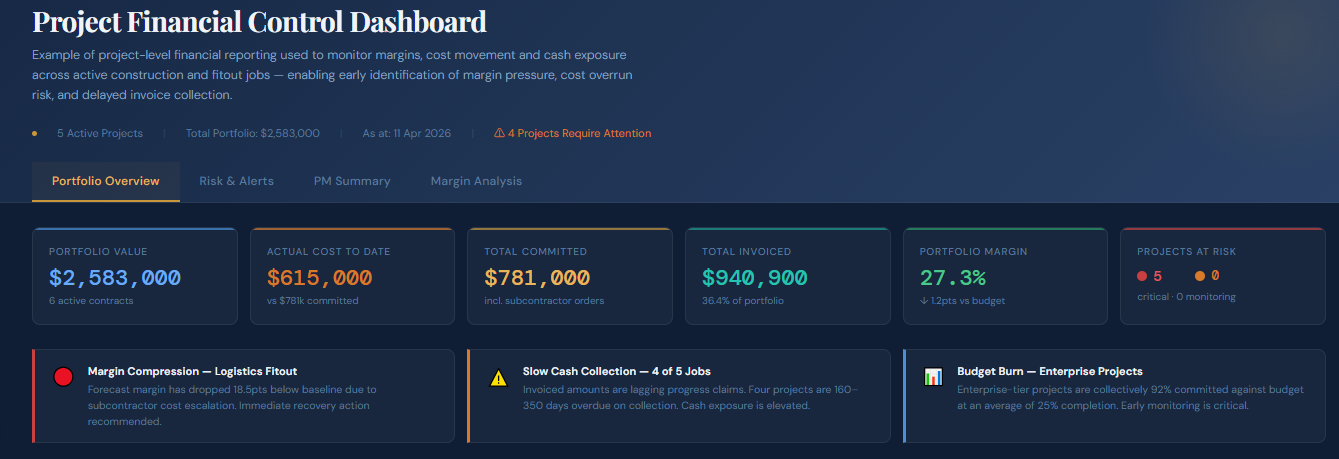
Portfolio overview and key risk indicators across active construction and project-based jobs.
Project-level margin and cost visibility across active jobs
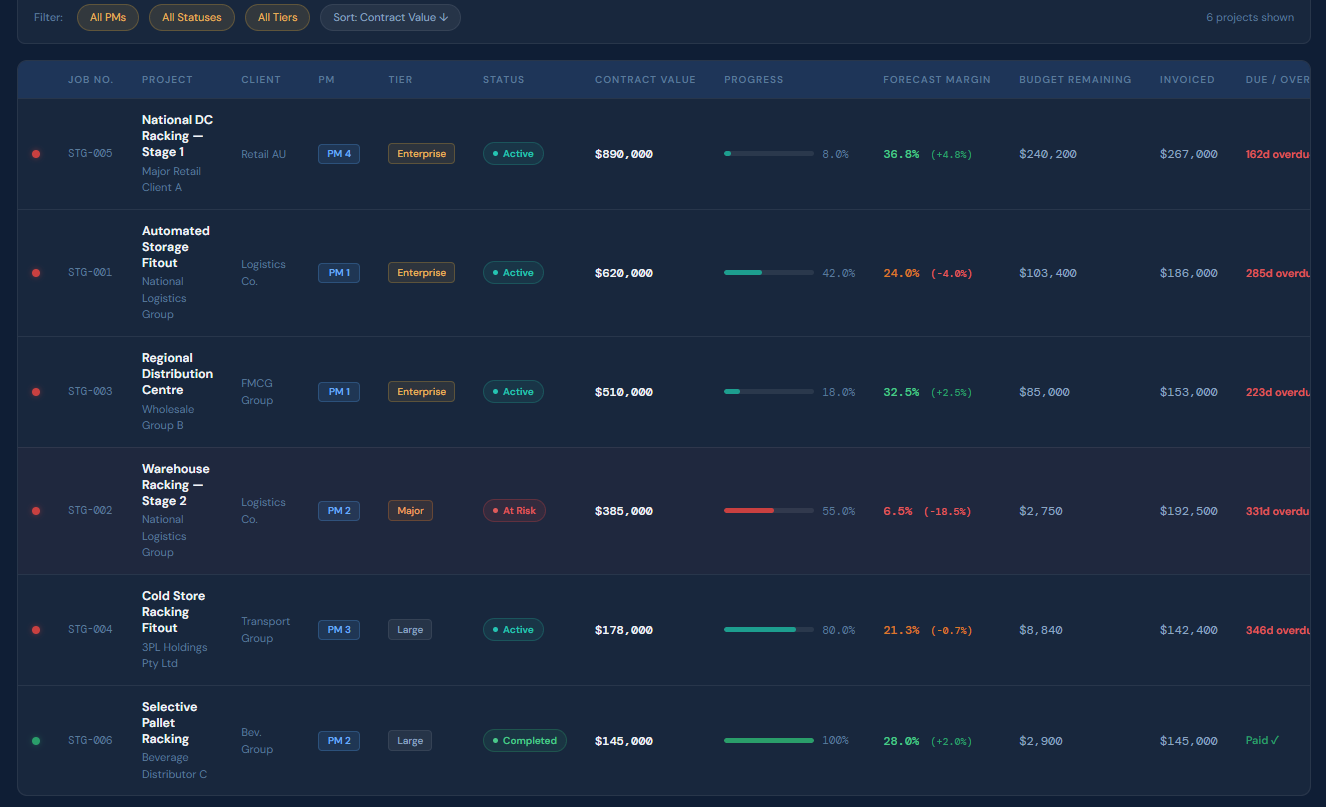
The exact dashboard structure depends on your project cycle, accounting system and reporting needs. The objective is always the same — identifying margin and cash flow issues early.
What we help with
RJ Partnering supports construction and project-based businesses with practical reporting and finance support focused on project profitability and margin control.
- Budget versus actual reporting
- Estimate at completion reviews
- Margin movement analysis
- Committed cost visibility
- Project dashboard reporting
- Cash flow and working capital visibility
- Monthly project finance review
- Finance process improvement and reporting setup
Why RJ Partnering
RJ Partnering combines bookkeeping, reporting and finance partnering with a strong understanding of project-based financial control. We help business owners move beyond basic data entry and gain clearer visibility over project performance.
- CPA-qualified and registered BAS Agent
- Strong background in finance reporting and business partnering
- Experience with project-based financial reporting environments
- Practical reporting focused on cash flow, margin and project risk
Our support is focused on finance, reporting, bookkeeping and business advisory needs. We do not provide legal, engineering or contract administration services.
Who this is best suited to
Project profitability and margin control support is best suited to construction and project-based businesses that need stronger visibility across active jobs.
- Builders and subcontractors managing multiple jobs
- Project-based businesses with long delivery cycles
- Businesses where final margin often differs from quoted margin
- Teams relying on manual spreadsheets for project cost tracking
- Owners who want earlier warning of margin or cash flow issues
Related Services & Resources
Construction Financial Services Overview · Financial Reporting · Financial Controlling & Partnering · Working Capital Management
Unsure which projects are actually making money?
We help construction and project-based businesses improve visibility over margins, committed costs and project profitability before issues become expensive.
Request a Project Profitability ReviewProject Profitability FAQs
Project profitability can change when material costs increase, labour takes longer than expected, variations are missed, scope changes are not recovered, or delays create extra cost.
Estimate at completion is a forecast of the expected final cost and margin of a project. It combines actual costs, committed costs and remaining forecast costs to estimate the final result.
Yes. We can help structure project reporting to show budget versus actual cost, committed spend, forecast cost to complete, margin movement and financial risk by project.
Not always. We can often start with your accounting system, spreadsheets and existing project records. Over time, we can help improve the reporting structure or dashboard depending on your business needs.
No. This support can also suit other project-based businesses where jobs run over time and profitability depends on labour, procurement, milestones, variations and delivery costs.